 RSS Feed - Blog
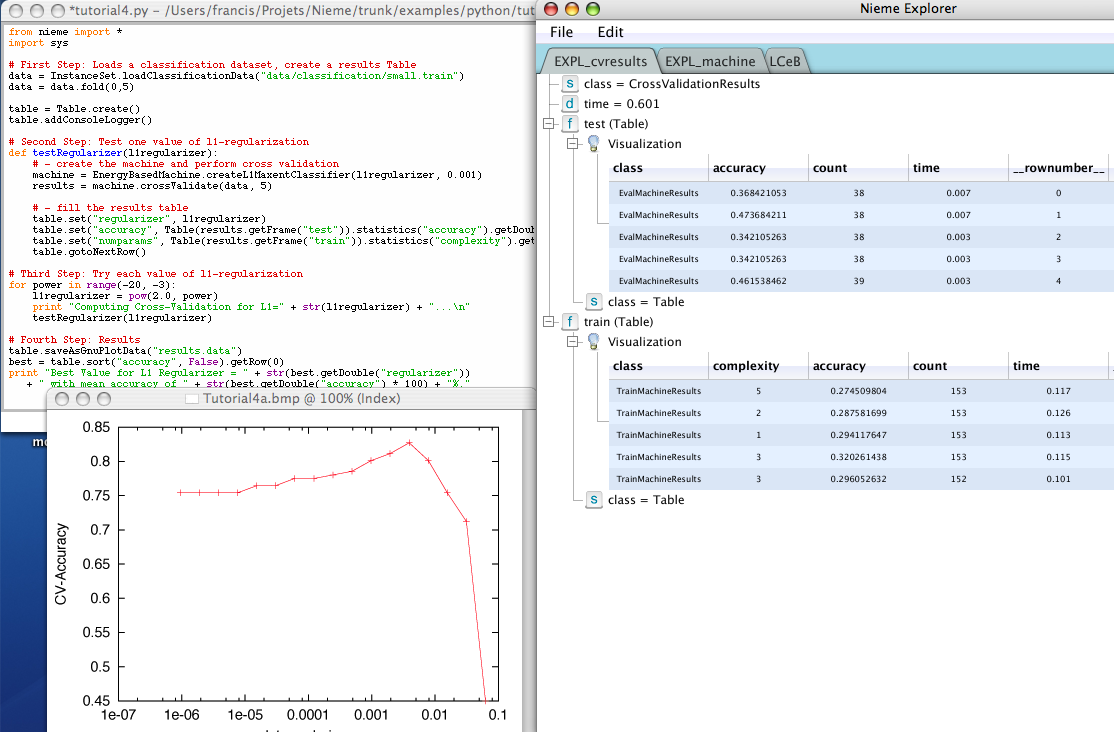
About: Nieme is a C++ machine learning library for large-scale classification, regression and ranking. It provides a simple interface available in C++, Python and Java and a user interface for visualization. Changes:Released Nieme 1.0
|


About: LIBOL is an open-source library with a family of state-of-the-art online learning algorithms for machine learning and big data analytics research. The current version supports 16 online algorithms for binary classification and 13 online algorithms for multiclass classification. Changes:In contrast to our last version (V0.2.3), the new version (V0.3.0) has made some important changes as follows: • Add a template and guide for adding new algorithms; • Improve parameter settings and make documentation clear; • Improve documentation on data formats and key functions; • Amend the "OGD" function to use different loss types; • Fixed some name inconsistency and other minor bugs.
|


About: This is the source code of the mloss.org website. Changes:Now works with newer django versions and fixes several warnings and minor bugs underneath. The only user visible change is probably that the subscription and bookmark buttons work again.
|

About: PyBrain is a versatile machine learning library for Python. Its goal is to provide flexible, easy-to-use yet still powerful algorithms for machine learning tasks, including a variety of predefined [...] Changes:
|
About: Massive Online Analysis (MOA) is a real time analytic tool for data streams. It is a software environment for implementing algorithms and running experiments for online learning from evolving data streams. MOA includes a collection of offline and online methods as well as tools for evaluation. In particular, it implements boosting, bagging, and Hoeffding Trees, all with and without Naive Bayes classifiers at the leaves. MOA supports bi-directional interaction with WEKA, the Waikato Environment for Knowledge Analysis, and it is released under the GNU GPL license. Changes:New version November 2013
|
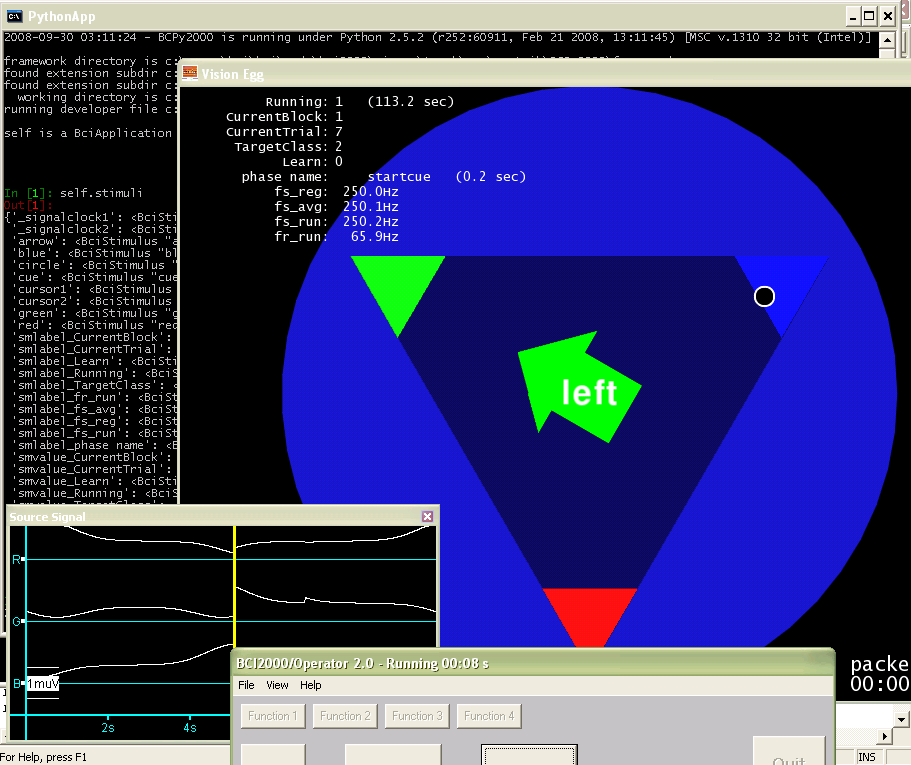
About: BCPy2000 provides a platform for rapid, flexible development of experimental Brain-Computer Interface systems based on the BCI2000.org project. From the developer's point of view, the implementation [...] Changes:Bugfixes and tuneups, and an expanded set of (some more-, some less-documented, optional tools)
|
|
About: DAL is an efficient and flexibible MATLAB toolbox for sparse/low-rank learning/reconstruction based on the dual augmented Lagrangian method. Changes:
|
About: LIBLINEAR is a linear classifier for data with millions of instances and features. It supports L2-regularized logistic regression (LR), L2-loss linear SVM, L1-loss linear SVM, and multi-class SVM Changes:Initial Announcement on mloss.org.
|
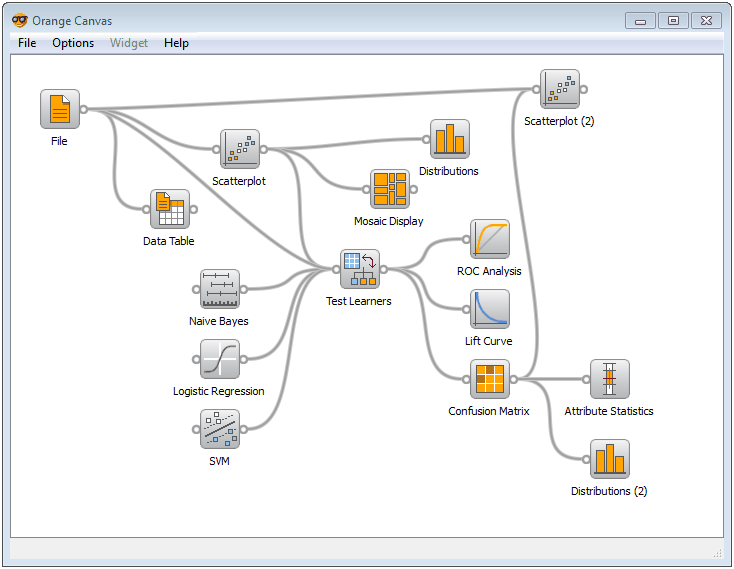
About: Orange is a component-based machine learning and data mining software. It includes a friendly yet powerful and flexible graphical user interface for visual programming. For more advanced use(r)s, [...] Changes:The core of the system (except the GUI) no longer includes any GPL code and can be licensed under the terms of BSD upon request. The graphical part remains under GPL. Changed the BibTeX reference to the paper recently published in JMLR MLOSS.
|
About: A MATLAB spectral clustering package to deal with large data sets. Our tool can handle large data sets (200,000 RCV1 data) on a 4GB memory general machine. Spectral clustering algorithm has been [...] Changes:
|
About: Breiman and Cutler's random forests for classification and regression Changes:Fetched by r-cran-robot on 2013-04-01 00:00:07.638240
|

About: C++ software for statistical classification, probability estimation and interpolation/non-linear regression using variable bandwidth kernel estimation. Changes:New in Version 0.9.8:
|

About: RLLib is a lightweight C++ template library that implements incremental, standard, and gradient temporal-difference learning algorithms in Reinforcement Learning. It is an optimized library for robotic applications and embedded devices that operates under fast duty cycles (e.g., < 30 ms). RLLib has been tested and evaluated on RoboCup 3D soccer simulation agents, physical NAO V4 humanoid robots, and Tiva C series launchpad microcontrollers to predict, control, learn behaviors, and represent learnable knowledge. The implementation of the RLLib library is inspired by the RLPark API, which is a library of temporal-difference learning algorithms written in Java. Changes:Current release version is v2.0.
|
About: A library of scalable Bayesian generalised linear models with fancy features Changes:
|
About: A Content Anomaly Detector based on n-Grams Changes:A teeny tiny fix to correctly handle input strings shorter than a registers width
|
About: xgboost: eXtreme Gradient Boosting It is an efficient and scalable implementation of gradient boosting framework. The package includes efficient linear model solver and tree learning algorithm. The package can automatically do parallel computation with OpenMP, and it can be more than 10 times faster than existing gradient boosting packages such as gbm or sklearn.GBM . It supports various objective functions, including regression, classification and ranking. The package is made to be extensible, so that user are also allowed to define there own objectives easily. The newest version of xgboost now supports distributed learning on various platforms such as hadoop, mpi and scales to even larger problems Changes:
|
About: This toolbox provides functions for maximizing and minimizing submodular set functions, with applications to Bayesian experimental design, inference in Markov Random Fields, clustering and others. Changes:
|
About: Bayesian treed Gaussian process models Changes:Fetched by r-cran-robot on 2012-02-01 00:00:11.834310
|
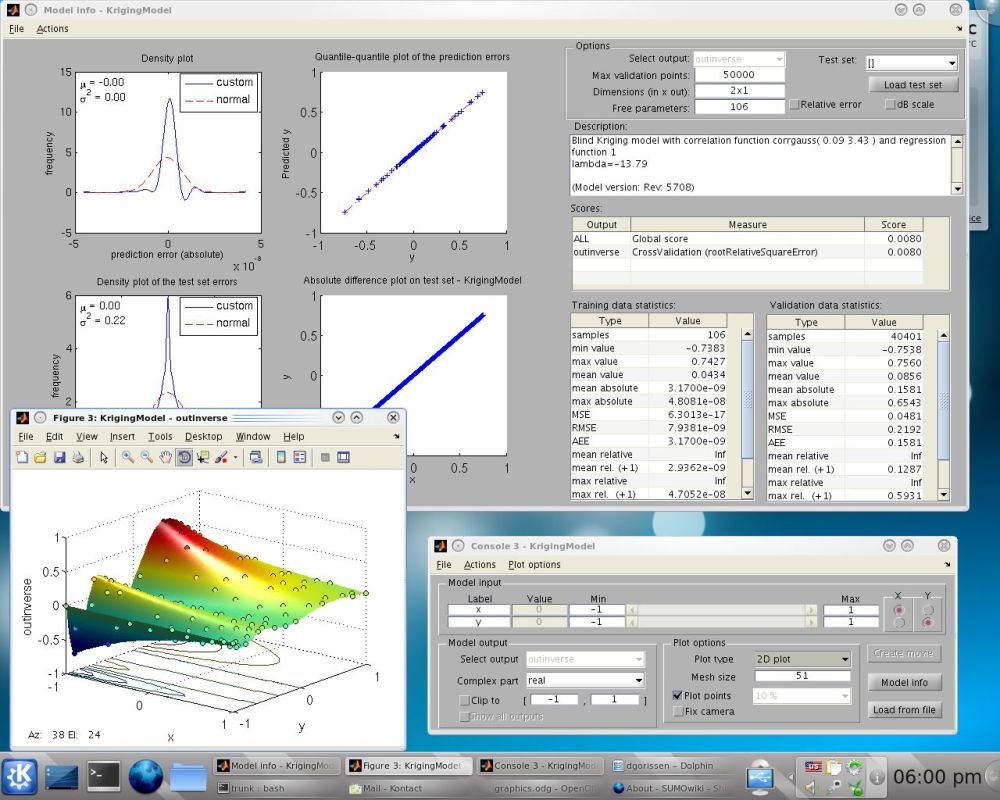
About: The SUMO Toolbox is a Matlab toolbox that automatically builds accurate surrogate models (also known as metamodels or response surface models) of a given data source (e.g., simulation code, data set, script, ...) within the accuracy and time constraints set by the user. The toolbox minimizes the number of data points (which it selects automatically) since they are usually expensive. Changes:Incremental update, fixing some cosmetic issues, coincides with JMLR publication.
|
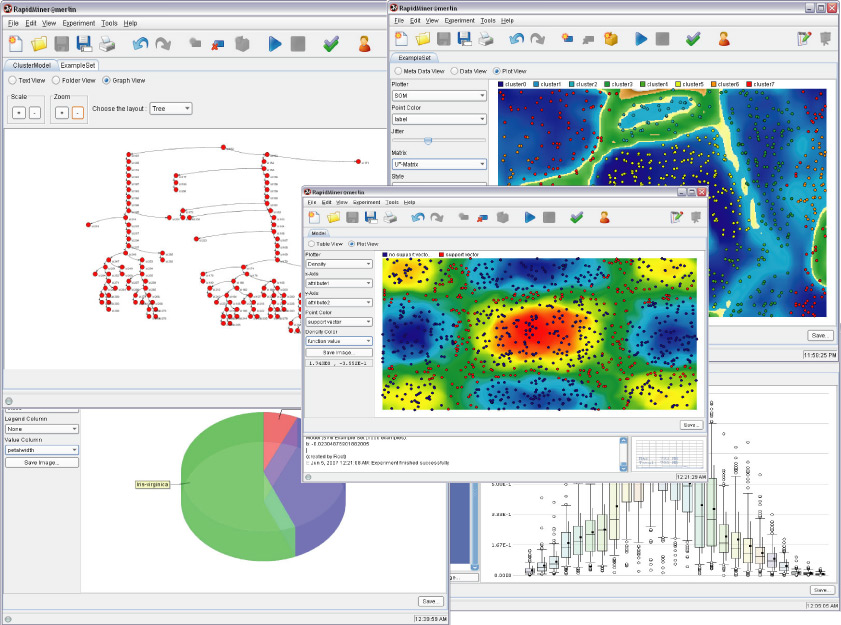
About: RapidMiner (formerly YALE) is one of the most widely used open-source data mining suites and software solutions due to its leading-edge technologies and its functional range. Applications of [...] Changes:Initial Announcement on mloss.org.
|