 RSS Feed - Blog
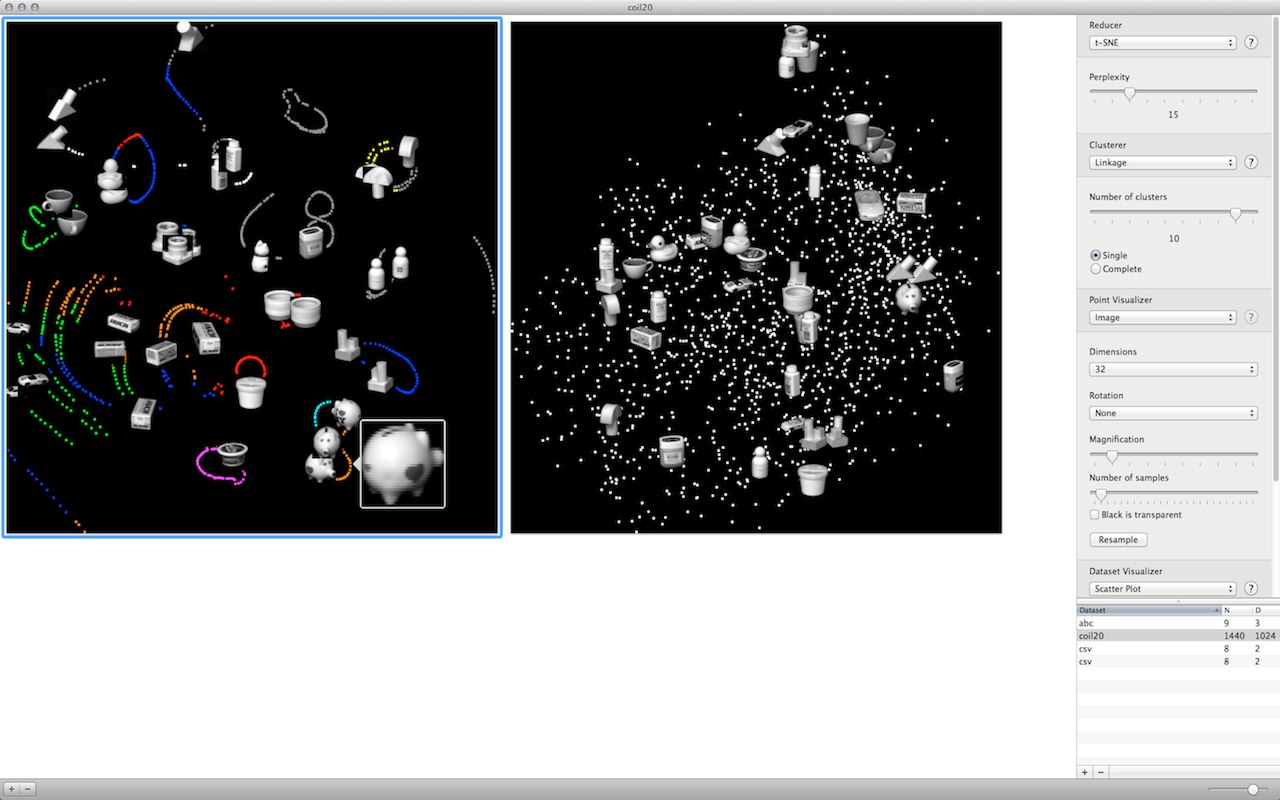
About: Divvy is a Mac OS X application for performing dimensionality reduction, clustering, and visualization. Changes:Initial Announcement on mloss.org.
|


About: This project is a C++ toolkit containing machine learning algorithms and tools for creating complex software in C++ to solve real world problems. Changes:In addition to a number of usability improvements, this release adds an implementation of the recent paper "One Millisecond Face Alignment with an Ensemble of Regression Trees" by Vahid Kazemi and Josephine Sullivan. This includes tools for performing high quality face landmarking as well as tools for training new landmarking models. See the face_landmark_detection_ex.cpp and train_shape_predictor_ex.cpp example programs for an introduction.
|


About: The DL-Learner framework contains several algorithms for supervised concept learning in Description Logics (DLs) and OWL. Changes:See http://dl-learner.org/wiki/ChangeLog.
|


About: DRVQ is a C++ library implementation of dimensionality-recursive vector quantization, a fast vector quantization method in high-dimensional Euclidean spaces under arbitrary data distributions. It is an approximation of k-means that is practically constant in data size and applies to arbitrarily high dimensions but can only scale to a few thousands of centroids. As a by-product of training, a tree structure performs either exact or approximate quantization on trained centroids, the latter being not very precise but extremely fast. Changes:Initial Announcement on mloss.org.
|
About: dysii is a C++ library for distributed probabilistic inference and learning in large-scale dynamical systems. It provides methods such as the Kalman, unscented Kalman, and particle filters and [...] Changes:Initial Announcement on mloss.org.
|

About: EANT Without Structural Optimization is used to learn a policy in either complete or partially observable reinforcement learning domains of continuous state and action space. Changes:Initial Announcement on mloss.org.
|
About: The Easysvm package provides a set of tools based on the Shogun toolbox allowing to train and test SVMs in a simple way. Changes:Fixes for shogun 0.7.3.
|
About: Eblearn is an object-oriented C++ library that implements various Changes:Initial Announcement on mloss.org.
|
About: Nonnegative Sparse Coding, Discriminative Semi-supervised Learning, sparse probability graph Changes:Initial Announcement on mloss.org.
|
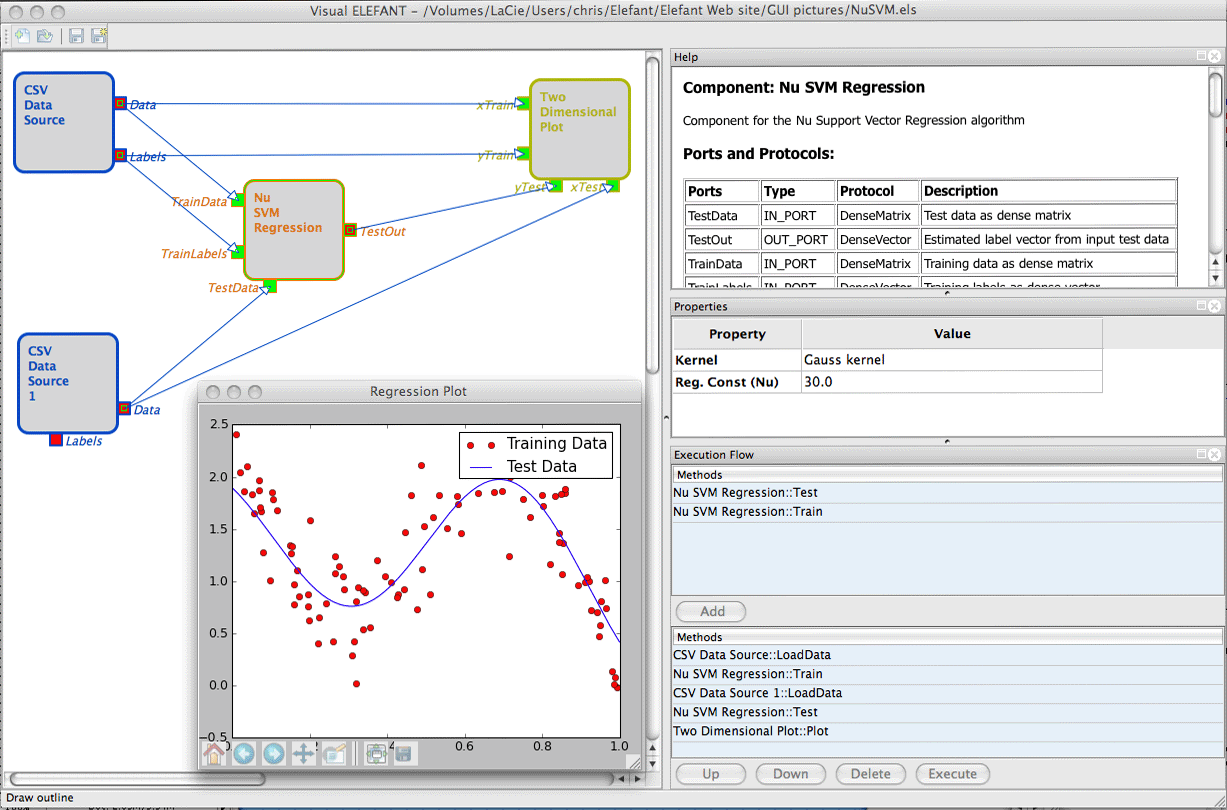
About: Elefant is an open source software platform for the Machine Learning community licensed under the Mozilla Public License (MPL) and developed using Python, C, and C++. We aim to make it the platform [...] Changes:This release contains the Stream module as a first step in the direction of providing C++ library support. Stream aims to be a software framework for the implementation of large scale online learning algorithms. Large scale, in this context, should be understood as something that does not fit in the memory of a standard desktop computer. Added Bundle Methods for Regularized Risk Minimization (BMRM) allowing to choose from a list of loss functions and solvers (linear and quadratic). Added the following loss classes: BinaryClassificationLoss, HingeLoss, SquaredHingeLoss, ExponentialLoss, LogisticLoss, NoveltyLoss, LeastMeanSquareLoss, LeastAbsoluteDeviationLoss, QuantileRegressionLoss, EpsilonInsensitiveLoss, HuberRobustLoss, PoissonRegressionLoss, MultiClassLoss, WinnerTakesAllMultiClassLoss, ScaledSoftMarginMultiClassLoss, SoftmaxMultiClassLoss, MultivariateRegressionLoss Graphical User Interface provides now extensive documentation for each component explaining state variables and port descriptions. Changed saving and loading of experiments to XML (thereby avoiding storage of large input data structures). Unified automatic input checking via new static typing extending Python properties. Full support for recursive composition of larger components containing arbitrary statically typed state variables.
|