
 RSS Feed - Blog
About: Optunity is a library containing various optimizers for hyperparameter tuning. Hyperparameter tuning is a recurrent problem in many machine learning tasks, both supervised and unsupervised.This package provides several distinct approaches to solve such problems including some helpful facilities such as cross-validation and a plethora of score functions. Changes:This minor release has the same feature set as Optunity 1.1.0, but incorporates several bug fixes, mostly related to the specification of structured search spaces.
|


About: DiffSharp is an automatic differentiation (AD) library providing gradients, Hessians, Jacobians, directional derivatives, and matrix-free Hessian- and Jacobian-vector products. It allows exact and efficient calculation of derivatives, with support for nesting. Changes:Version 0.7.0 is a reimplementation of the library with support for linear algebra primitives, BLAS/LAPACK, 32- and 64-bit precision and different CPU/GPU backends Changed: Namespaces have been reorganized and simplified. This is a breaking change. There is now just one AD implementation, under DiffSharp.AD (with DiffSharp.AD.Float32 and DiffSharp.AD.Float64 variants, see below). This internally makes use of forward or reverse AD as needed. Added: Support for 32 bit (single precision) and 64 bit (double precision) floating point operations. All modules have Float32 and Float64 versions providing the same functionality with the specified precision. 32 bit floating point operations are significantly faster (as much as twice as fast) on many current systems. Added: DiffSharp now uses the OpenBLAS library by default for linear algebra operations. The AD operations with the types D for scalars, DV for vectors, and DM for matrices use the underlying linear algebra backend for highly optimized native BLAS and LAPACK operations. For non-BLAS operations (such as Hadamard products and matrix transpose), parallel implementations in managed code are used. All operations with the D, DV, and DM types support forward and reverse nested AD up to any level. This also paves the way for GPU backends (CUDA/CuBLAS) which will be introduced in following releases. Please see the documentation and API reference for information about how to use the D, DV, and DM types. (Deprecated: The FsAlg generic linear algebra library and the Vector<'T> and Matrix<'T> types are no longer used.) Fixed: Reverse mode AD has been reimplemented in a tail-recursive way for better performance and preventing StackOverflow exceptions encountered in previous versions. Changed: The library now uses F# 4.0 (FSharp.Core 4.4.0.0). Changed: The library is now 64 bit only, meaning that users should set "x64" as the platform target for all build configurations. Fixed: Overall bug fixes.
|

About: SALSA (Software lab for Advanced machine Learning with Stochastic Algorithms) is an implementation of the well-known stochastic algorithms for Machine Learning developed in the high-level technical computing language Julia. The SALSA software package is designed to address challenges in sparse linear modelling, linear and non-linear Support Vector Machines applied to large data samples with user-centric and user-friendly emphasis. Changes:Initial Announcement on mloss.org.
|

About: This project is a C++ toolkit containing machine learning algorithms and tools for creating complex software in C++ to solve real world problems. Changes:This release adds new clustering tools as well as upgrades the shape_predictor to allow training on datasets with missing landmarks. It also includes bug fixes and minor usability improvements.
|


About: R package implementing statistical test and post hoc tests to compare multiple algorithms in multiple problems. Changes:Initial Announcement on mloss.org.
|

About: BayesOpt is an efficient, C++ implementation of the Bayesian optimization methodology for nonlinear-optimization, experimental design and stochastic bandits. In the literature it is also called Sequential Kriging Optimization (SKO) or Efficient Global Optimization (EGO). There are also interfaces for C, Matlab/Octave and Python. Changes:-Fixed bugs and doc typos
|
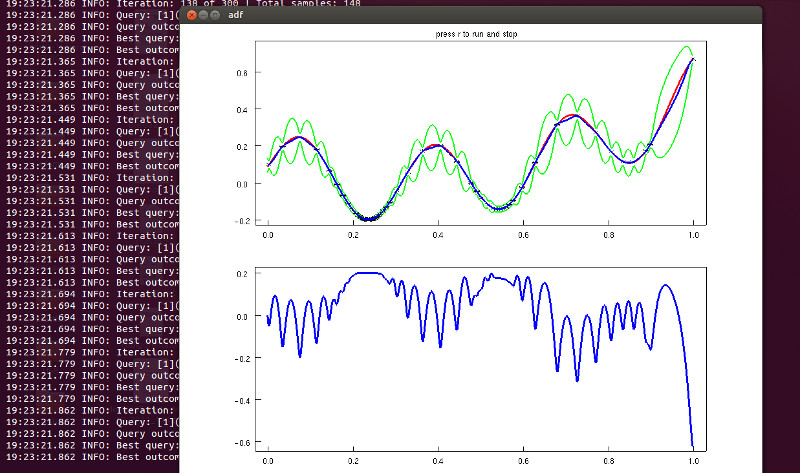
About: This package is an implementation of a linear RankSVM solver with non-convex regularization. Changes:Initial Announcement on mloss.org.
|
About: Universal Python-written numerical optimization toolbox. Problems: NLP, LP, QP, NSP, MILP, LSP, LLSP, MMP, GLP, SLE, MOP etc; general logical constraints, categorical variables, automatic differentiation, stochastic programming, interval analysis, many other goodies Changes:http://openopt.org/Changelog
|
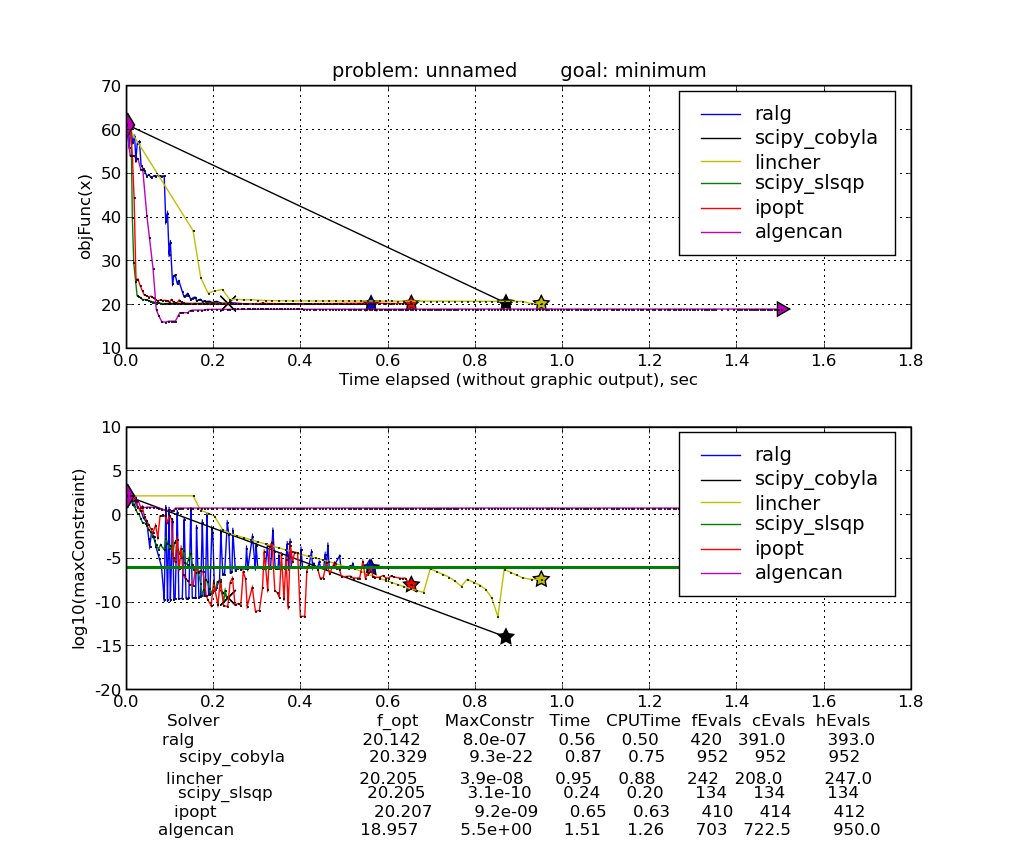


About: This is an optimization library based on Social Impact Theory(SITO). The optimizer works in the same way as PSO and GA. Changes:A new variant 'Continuous Opinion Dynamics Optimizer (CODO)' has been implemented in this version. Minor changes in implementation of objective function.
|
About: DAL is an efficient and flexibible MATLAB toolbox for sparse/low-rank learning/reconstruction based on the dual augmented Lagrangian method. Changes:
|
About: minFunc is a Matlab function for unconstrained optimization of differentiable real-valued multivariate functions using line-search methods. It uses an interface very similar to the Matlab Optimization Toolbox function fminunc, and can be called as a replacement for this function. On many problems, minFunc requires fewer function evaluations to converge than fminunc (or minimize.m). Further it can optimize problems with a much larger number of variables (fminunc is restricted to several thousand variables), and uses a line search that is robust to several common function pathologies. Changes:Initial Announcement on mloss.org.
|
About: [FACTORIE](http://factorie.cs.umass.edu) is a toolkit for deployable probabilistic modeling, implemented as a software library in [Scala](http://scala-lang.org). It provides its users with a succinct language for creating [factor graphs](http://en.wikipedia.org/wiki/Factor_graph), estimating parameters and performing inference. It also has implementations of many machine learning tools and a full NLP pipeline. Changes:Initial Announcement on mloss.org.
|

About: PLEASD: A Matlab Toolbox for Structured Learning Changes:Initial Announcement on mloss.org.
|
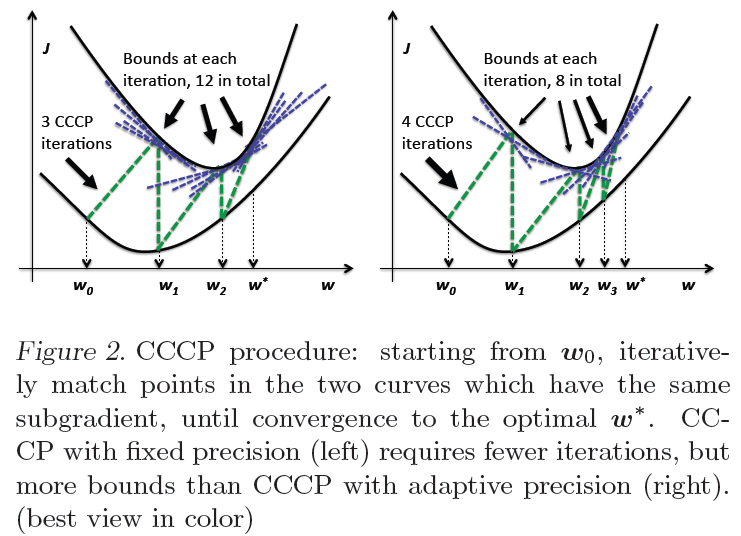
About: The Maja Machine Learning Framework (MMLF) is a general framework for problems in the domain of Reinforcement Learning (RL) written in python. It provides a set of RL related algorithms and a set of benchmark domains. Furthermore it is easily extensible and allows to automate benchmarking of different agents. Changes:
|
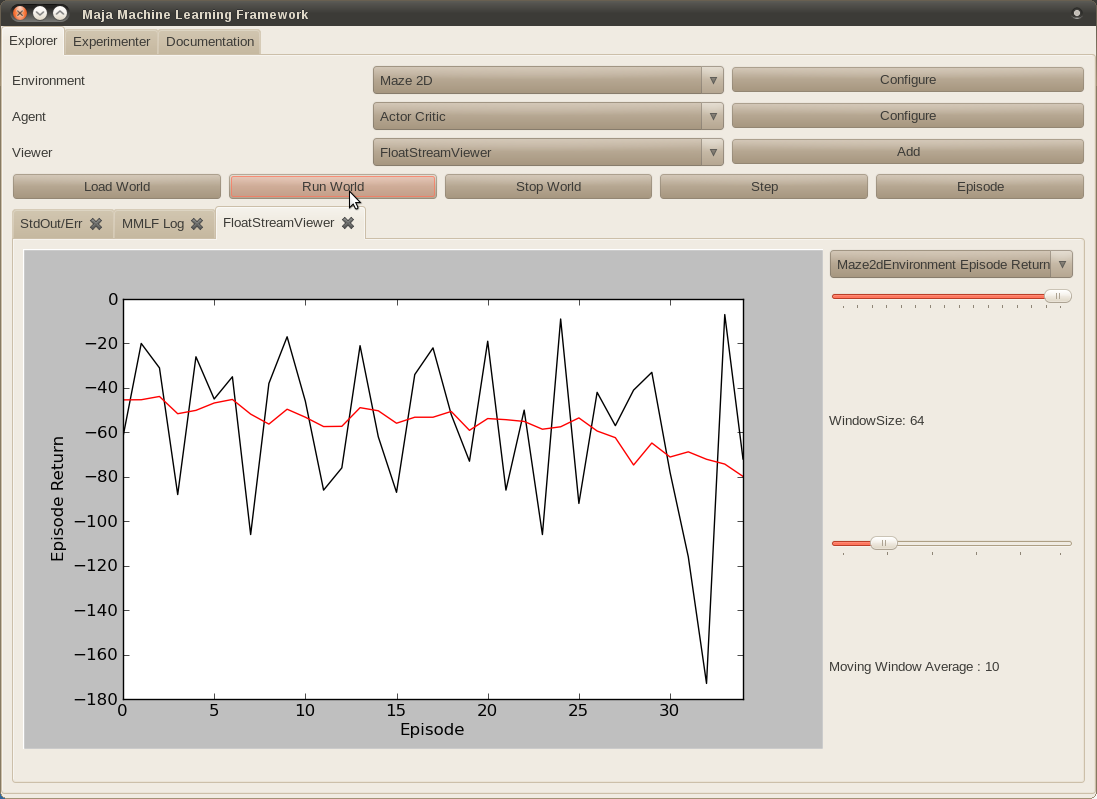
About: This toolbox provides functions for maximizing and minimizing submodular set functions, with applications to Bayesian experimental design, inference in Markov Random Fields, clustering and others. Changes:
|
About: PyBrain is a versatile machine learning library for Python. Its goal is to provide flexible, easy-to-use yet still powerful algorithms for machine learning tasks, including a variety of predefined [...] Changes:
|
About: SHARK is a modular C++ library for the design and optimization of adaptive systems. It provides various machine learning and computational intelligence techniques. Changes:
|

About: The Computational Infrastructure for Operations Research (COIN-OR) project is an initiative to spur the development of open-source software for the operations research community. Changes:Initial Announcement on mloss.org.
|

About: SeDuMi is a software package to solve optimization problems over symmetric cones. This includes linear, quadratic, second order conic and semidefinite optimization, and any combination of these. Changes:Initial Announcement on mloss.org.
|