 RSS Feed - Blog
About: This provide a semi-supervised learning method based co-training for RGB-D object recognition. Besides, we evaluate four state-of-the-art feature learing method under the semi-supervised learning framework. Changes:Initial Announcement on mloss.org.
|


About: pySPACE is the abbreviation for "Signal Processing and Classification Environment in Python using YAML and supporting parallelization". It is a modular software for processing of large data streams that has been specifically designed to enable distributed execution and empirical evaluation of signal processing chains. Various signal processing algorithms (so called nodes) are available within the software, from finite impulse response filters over data-dependent spatial filters (e.g. CSP, xDAWN) to established classifiers (e.g. SVM, LDA). pySPACE incorporates the concept of node and node chains of the MDP framework. Due to its modular architecture, the software can easily be extended with new processing nodes and more general operations. Large scale empirical investigations can be configured using simple text- configuration files in the YAML format, executed on different (distributed) computing modalities, and evaluated using an interactive graphical user interface. Changes:improved testing, improved documentation, windows compatibility, more algorithms
|

About: revised version of BACOM Changes:Initial Announcement on mloss.org.
|
About: A MATLAB toolkit for performing generalized regression with equality/inequality constraints on the function value/gradient. Changes:Initial Announcement on mloss.org.
|
About: The implementation of adaptive probabilistic mappings. Changes:Initial Announcement on mloss.org.
|

About: Script-friendly command-line tools for machine learning and data mining tasks. (The command-line tools wrap functionality from a public domain C++ class library.) Changes:Added support for CUDA GPU-parallelized neural network layers, and several other new features. Full list of changes at http://waffles.sourceforge.net/docs/changelog.html
|


About: ARTOS can be used to quickly learn models for visual object detection without having to collect a set of samples manually. To make this possible, it uses ImageNet, a large image database with more than 20,000 categories. Changes:Initial Announcement on mloss.org.
|
About: Encog is a Machine Learning framework for Java, C#, Javascript and C/C++ that supports SVM's, Genetic Programming, Bayesian Networks, Hidden Markov Models and other algorithms. Changes:Changes for Encog 3.2: Issue #53: Fix Out Of Range Bug In BasicMLSequenceSet. Issue #52: Unhandled exception in Encog.Util.File.ResourceLoader.CreateStream (ResourceLoader.cs) Issue #50: Concurrency bugs in PruneIncremental Issue #48: Unit Tests Failing - TestHessian Issue #46: Couple of small fixes - Temporal DataSet and SCG training Issue #45: Fixed EndMinutesStrategy to correctly evaluate ShouldStop after the specified number of minutes have elapsed. Issue #44: Encog.ML.Data.Basic.BasicMLDataPairCentroid.Add() & .Remove() Issue #43: Unit Tests Failing - Matrix not full rank Issue #42: Nuget - NuSpec Issue #36: Load Examples easier
|
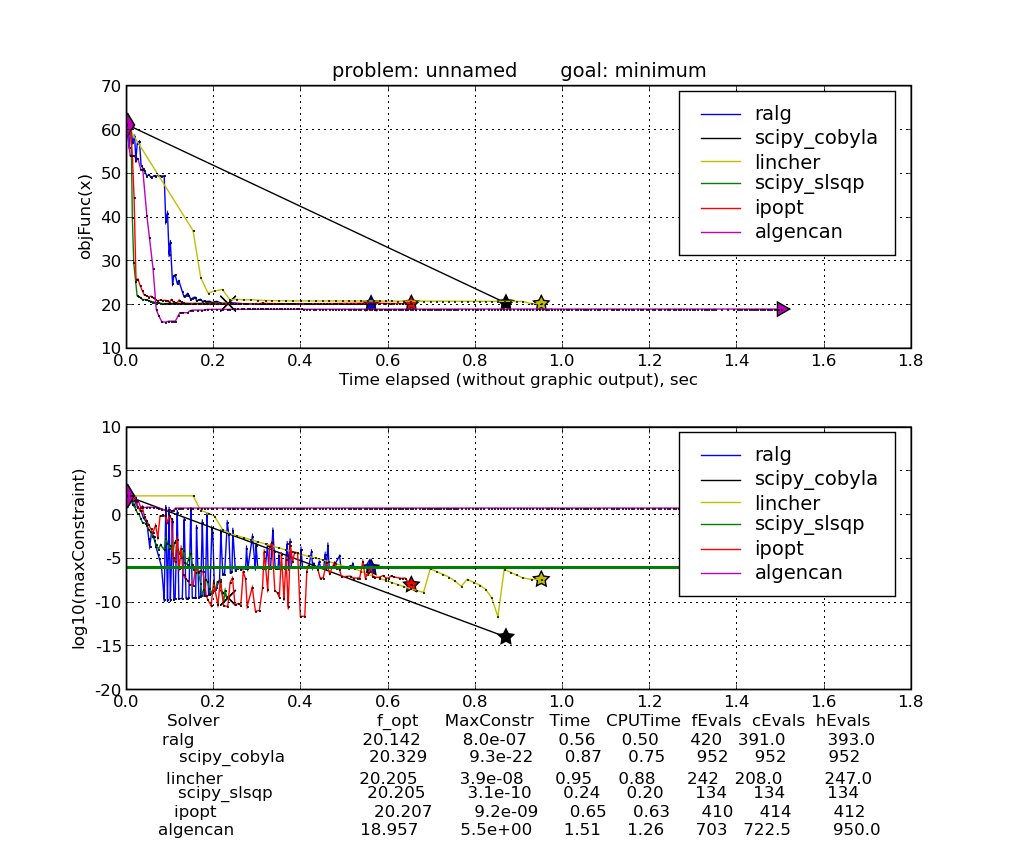
About: Universal Python-written numerical optimization toolbox. Problems: NLP, LP, QP, NSP, MILP, LSP, LLSP, MMP, GLP, SLE, MOP etc; general logical constraints, categorical variables, automatic differentiation, stochastic programming, interval analysis, many other goodies Changes:http://openopt.org/Changelog
|


About: GPU-accelerated java deep neural networks Changes:Initial Announcement on mloss.org.
|
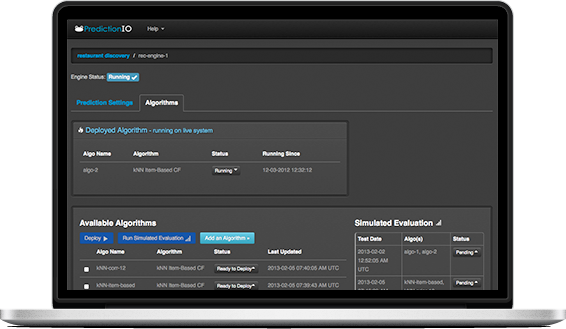
About: Open Source Machine Learning Server Changes:
See release notes - https://predictionio.atlassian.net/secure/ReleaseNote.jspa?projectId=10000&version=11801
|
About: This is an unoptimized implementation of the RFD binary descriptor, which is published in the following paper. B. Fan, et al. Receptive Fields Selection for Binary Feature Description. IEEE Transaction on Image Processing, 2014. doi: http://dx.doi.org/10.1109/TIP.2014.2317981 Changes:Initial Announcement on mloss.org.
|
About: Generalised Stirling Numbers for Pitman-Yor Processes: this library provides ways of computing generalised 2nd-order Stirling numbers for Pitman-Yor and Dirichlet processes. Included is a tester and parameter optimiser. This accompanies Buntine and Hutter's article: http://arxiv.org/abs/1007.0296, and a series of papers by Buntine and students at NICTA and ANU. Changes:Moved repository to GitHub, and added thread support to use the main table lookups in multi-threaded code.
|
About: GradMC is an algorithm for MR motion artifact removal implemented in Matlab Changes:Added support for multi-rigid motion correction.
|
About: Lightweight CPU/GPU Matrix/Tensor Template Library in C++/CUDA. Support element-wise expression expand in high performance. Code once, run smoothly on both GPU and CPU Changes:Initial Announcement on mloss.org.
|
About: CXXNET (spelled as: C plus plus net) is a neural network toolkit build on mshadow(https://github.com/tqchen/mshadow). It is yet another implementation of (convolutional) neural network. It is in C++, with about 1000 lines of network layer implementations, easily configuration via config file, and can get the state of art performance. Changes:Initial Announcement on mloss.org.
|
About: Tapkee is an efficient and flexible C++ template library for dimensionality reduction. Changes:Initial Announcement on mloss.org.
|
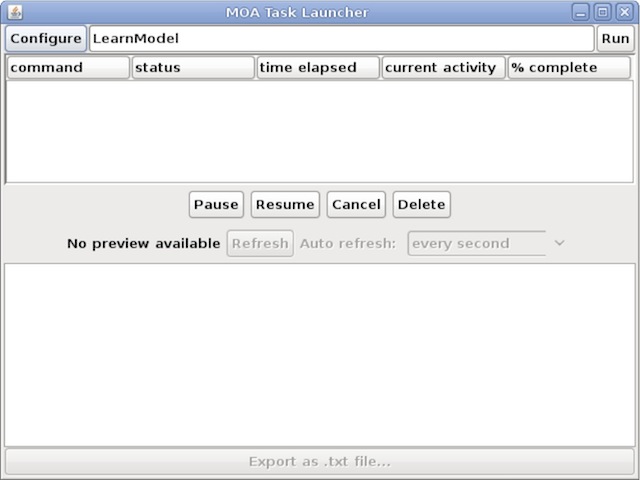
About: Massive Online Analysis (MOA) is a real time analytic tool for data streams. It is a software environment for implementing algorithms and running experiments for online learning from evolving data streams. MOA includes a collection of offline and online methods as well as tools for evaluation. In particular, it implements boosting, bagging, and Hoeffding Trees, all with and without Naive Bayes classifiers at the leaves. MOA supports bi-directional interaction with WEKA, the Waikato Environment for Knowledge Analysis, and it is released under the GNU GPL license. Changes:New version November 2013
|
About: MultiBoost is a multi-purpose boosting package implemented in C++. It is based on the multi-class/multi-task AdaBoost.MH algorithm [Schapire-Singer, 1999]. Basic base learners (stumps, trees, products, Haar filters for image processing) can be easily complemented by new data representations and the corresponding base learners, without interfering with the main boosting engine. Changes:Major changes :
Minor fixes:
|

About: The package "fastclime" provides a method of recover the precision matrix efficiently by applying parametric simplex method. The computation is based on a linear optimization solver. It also contains a generic LP solver and a parameterized LP solver using parametric simplex method. Changes:Initial Announcement on mloss.org.
|