
 RSS Feed - Blog
About: MLweb is an open source project that aims at bringing machine learning capabilities into web pages and web applications, while maintaining all computations on the client side. It includes (i) a javascript library to enable scientific computing within web pages, (ii) a javascript library implementing machine learning algorithms for classification, regression, clustering and dimensionality reduction, (iii) a web application providing a matlab-like development environment. Changes:
|


About: Armadillo is a template C++ linear algebra library aiming towards a good balance between speed and ease of use, with a function syntax similar to MATLAB. Matrix decompositions are provided through optional integration with LAPACK, or one of its high performance drop-in replacements (eg. Intel MKL, OpenBLAS). Changes:
|



About: A platform-independent C++ framework for machine learning, graphical models, and computer vision research and development. Changes:Version 1.9:
|


|
About: The Libra Toolkit is a collection of algorithms for learning and inference with discrete probabilistic models, including Bayesian networks, Markov networks, dependency networks, sum-product networks, arithmetic circuits, and mixtures of trees. Changes:Version 1.1.2c (6/24/2015):
|
About: xgboost: eXtreme Gradient Boosting It is an efficient and scalable implementation of gradient boosting framework. The package includes efficient linear model solver and tree learning algorithm. The package can automatically do parallel computation with OpenMP, and it can be more than 10 times faster than existing gradient boosting packages such as gbm or sklearn.GBM . It supports various objective functions, including regression, classification and ranking. The package is made to be extensible, so that user are also allowed to define there own objectives easily. The newest version of xgboost now supports distributed learning on various platforms such as hadoop, mpi and scales to even larger problems Changes:
|
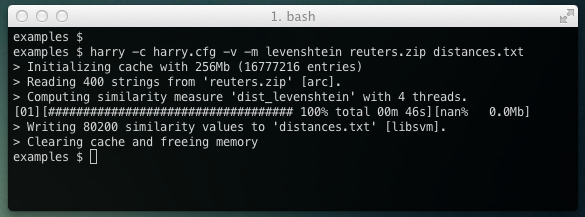
About: A Tool for Measuring String Similarity Changes:The new release supports measuring string similarity at the granularity of bytes, bits and tokens. A Python interface has been added. Several minor bugs have been fixed.
|
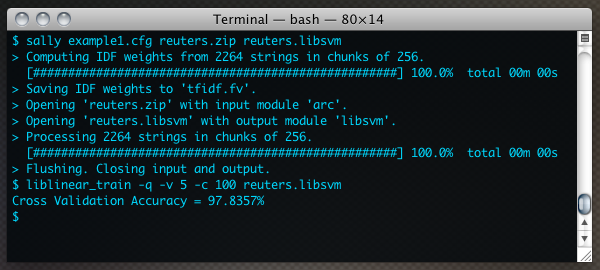
About: A Tool for Embedding Strings in Vector Spaces Changes:Support for explicit selection of granularity added. Several minor bug fixes. We have reached 1.0
|
About: Libcmaes is a multithreaded C++11 library (with Python bindings) for high performance blackbox stochastic optimization of difficult, possibly non-linear and non-convex functions, using the CMA-ES algorithm for Covariance Matrix Adaptation Evolution Strategy. Libcmaes is useful to minimize / maximize any function, without information regarding gradient or derivability. Changes:This is a major release, with several novelties, improvements and fixes, among which:
|
About: A template based C++ reinforcement learning library Changes:Initial Announcement on mloss.org.
|
About: Gaussian processes with general nonlinear likelihoods using the unscented transform or Taylor series linearisation. Changes:Initial Announcement on mloss.org.
|
About: Lua-MapReduce framework implemented in Lua using luamongo driver and MongoDB as storage. It follows Iterative MapReduce for training of Machine Learning statistical models. Changes:
|
About: pySPACE is the abbreviation for "Signal Processing and Classification Environment in Python using YAML and supporting parallelization". It is a modular software for processing of large data streams that has been specifically designed to enable distributed execution and empirical evaluation of signal processing chains. Various signal processing algorithms (so called nodes) are available within the software, from finite impulse response filters over data-dependent spatial filters (e.g. CSP, xDAWN) to established classifiers (e.g. SVM, LDA). pySPACE incorporates the concept of node and node chains of the MDP framework. Due to its modular architecture, the software can easily be extended with new processing nodes and more general operations. Large scale empirical investigations can be configured using simple text- configuration files in the YAML format, executed on different (distributed) computing modalities, and evaluated using an interactive graphical user interface. Changes:improved testing, improved documentation, windows compatibility, more algorithms
|

About: A Content Anomaly Detector based on n-Grams Changes:Lots and lots of cool new features and bugfixes ;)
|
About: Encog is a Machine Learning framework for Java, C#, Javascript and C/C++ that supports SVM's, Genetic Programming, Bayesian Networks, Hidden Markov Models and other algorithms. Changes:Changes for Encog 3.2: Issue #53: Fix Out Of Range Bug In BasicMLSequenceSet. Issue #52: Unhandled exception in Encog.Util.File.ResourceLoader.CreateStream (ResourceLoader.cs) Issue #50: Concurrency bugs in PruneIncremental Issue #48: Unit Tests Failing - TestHessian Issue #46: Couple of small fixes - Temporal DataSet and SCG training Issue #45: Fixed EndMinutesStrategy to correctly evaluate ShouldStop after the specified number of minutes have elapsed. Issue #44: Encog.ML.Data.Basic.BasicMLDataPairCentroid.Add() & .Remove() Issue #43: Unit Tests Failing - Matrix not full rank Issue #42: Nuget - NuSpec Issue #36: Load Examples easier
|
About: APRIL-ANN toolkit (A Pattern Recognizer In Lua with Artificial Neural Networks). This toolkit incorporates ANN algorithms (as dropout, stacked denoising auto-encoders, convolutional neural networks), with other pattern recognition methods as hidden makov models (HMMs) among others. Changes:
|

About: Generalised Stirling Numbers for Pitman-Yor Processes: this library provides ways of computing generalised 2nd-order Stirling numbers for Pitman-Yor and Dirichlet processes. Included is a tester and parameter optimiser. This accompanies Buntine and Hutter's article: http://arxiv.org/abs/1007.0296, and a series of papers by Buntine and students at NICTA and ANU. Changes:Moved repository to GitHub, and added thread support to use the main table lookups in multi-threaded code.
|
About: Lightweight CPU/GPU Matrix/Tensor Template Library in C++/CUDA. Support element-wise expression expand in high performance. Code once, run smoothly on both GPU and CPU Changes:Initial Announcement on mloss.org.
|
About: CXXNET (spelled as: C plus plus net) is a neural network toolkit build on mshadow(https://github.com/tqchen/mshadow). It is yet another implementation of (convolutional) neural network. It is in C++, with about 1000 lines of network layer implementations, easily configuration via config file, and can get the state of art performance. Changes:Initial Announcement on mloss.org.
|
About: MultiBoost is a multi-purpose boosting package implemented in C++. It is based on the multi-class/multi-task AdaBoost.MH algorithm [Schapire-Singer, 1999]. Basic base learners (stumps, trees, products, Haar filters for image processing) can be easily complemented by new data representations and the corresponding base learners, without interfering with the main boosting engine. Changes:Major changes :
Minor fixes:
|
