
 RSS Feed - Blog
About: A Python library that allows you to define, optimize, and evaluate mathematical expressions involving multi-dimensional arrays efficiently. Dynamically generates CPU and GPU modules for good performance. Deep Learning Tutorials illustrate deep learning with Theano. Changes:Theano 0.6 (December 3th, 2013) Highlight: 0.6rc4 skipped for a technical reason. Highlights (since 0.6rc3): Too much changes in 0.6rc1, 0.6rc2 and 0.6rc3 to list here. See https://github.com/Theano/Theano/blob/master/NEWS.txt for details.
|


About: CARP: The Clustering Algorithms’ Referee Package Changes:Generalized overlap error and some bugs have been fixed
|


About: Bob is a free signal-processing and machine learning toolbox originally developed by the Biometrics group at Idiap Research Institute, in Switzerland. Changes:Bob 1.2.0 comes about 1 year after we released Bob 1.0.0. This new release comes with a big set of new features and lots of changes under the hood to make your experiments run even smoother. Some statistics: Diff URL: https://github.com/idiap/bob/compare/v1.1.4...HEAD Commits: 629 Files changed: 954 Contributors: 7 Here is a quick list of things you should pay attention for while integrating your satellite packages against Bob 1.2.x:
For a detailed list of changes and additions, please look at our Changelog page for this release and minor updates: https://github.com/idiap/bob/wiki/Changelog-from-1.1.4-to-1.2 https://github.com/idiap/bob/wiki/Changelog-from-1.2.0-to-1.2.1 https://github.com/idiap/bob/wiki/Changelog-from-1.2.1-to-1.2.2
|

About: FABIA is a biclustering algorithm that clusters rows and columns of a matrix simultaneously. Consequently, members of a row cluster are similar to each other on a subset of columns and, analogously, members of a column cluster are similar to each other on a subset of rows. Biclusters are found by factor analysis where both the factors and the loading matrix are sparse. FABIA is a multiplicative model that extracts linear dependencies between samples and feature patterns. Applications include detection of transcriptional modules in gene expression data and identification of haplotypes/>identity by descent< consisting of rare variants obtained by next generation sequencing. Changes:CHANGES IN VERSION 2.8.0NEW FEATURES CHANGES IN VERSION 2.4.0CHANGES IN VERSION 2.3.1NEW FEATURES 2.0.0:
1.4.0:
|


About: The scikit-learn project is a machine learning library in Python. Changes:Update for 0.14.1
|
About: The open-source C-package fastICA implements the fastICA algorithm of Aapo Hyvarinen et al. (URL: http://www.cs.helsinki.fi/u/ahyvarin/) to perform Independent Component Analysis (ICA) and Projection Pursuit. fastICA is released under the GNU Public License (GPL). Changes:Initial Announcement on mloss.org.
|
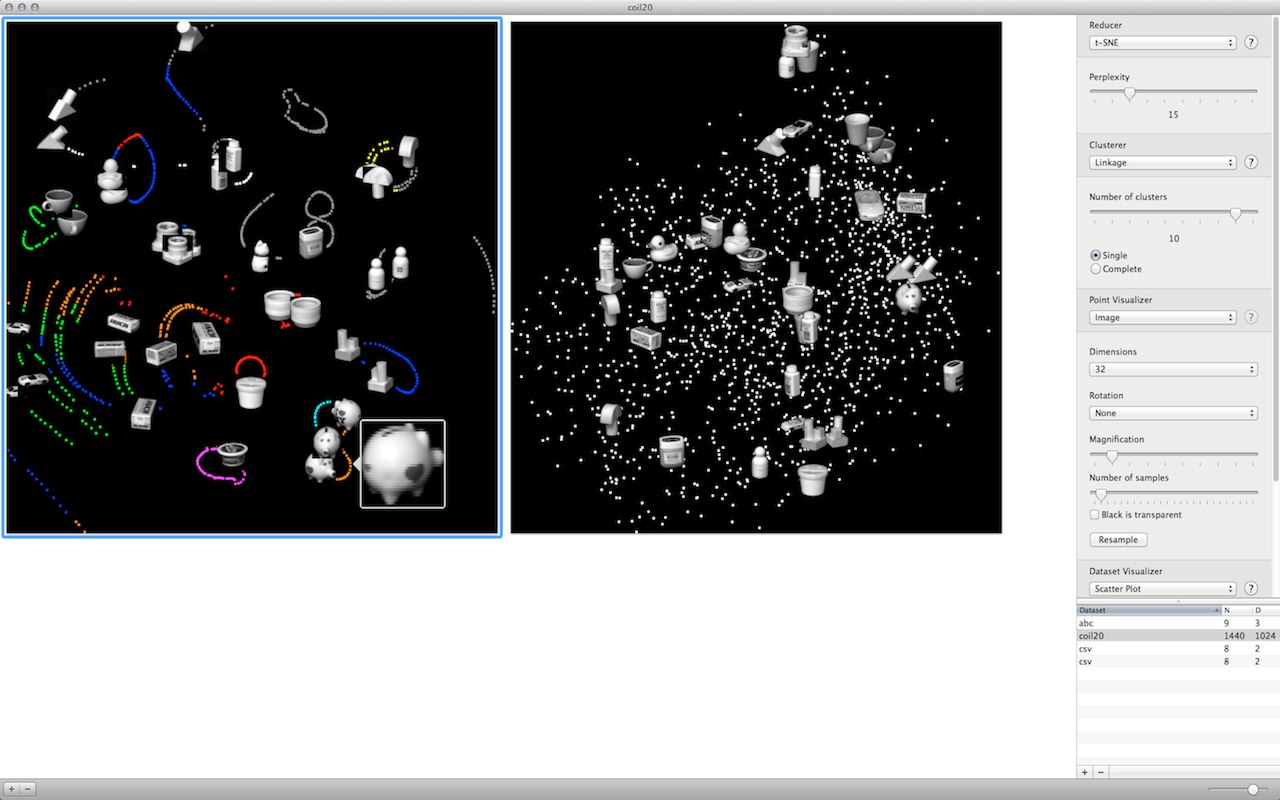
About: Divvy is a Mac OS X application for performing dimensionality reduction, clustering, and visualization. Changes:Initial Announcement on mloss.org.
|
About: Python Machine Learning Toolkit Changes:Added LASSO (using coordinate descent optimization). Made SVM classification (learning and applying) much faster: 2.5x speedup on yeast UCI dataset.
|
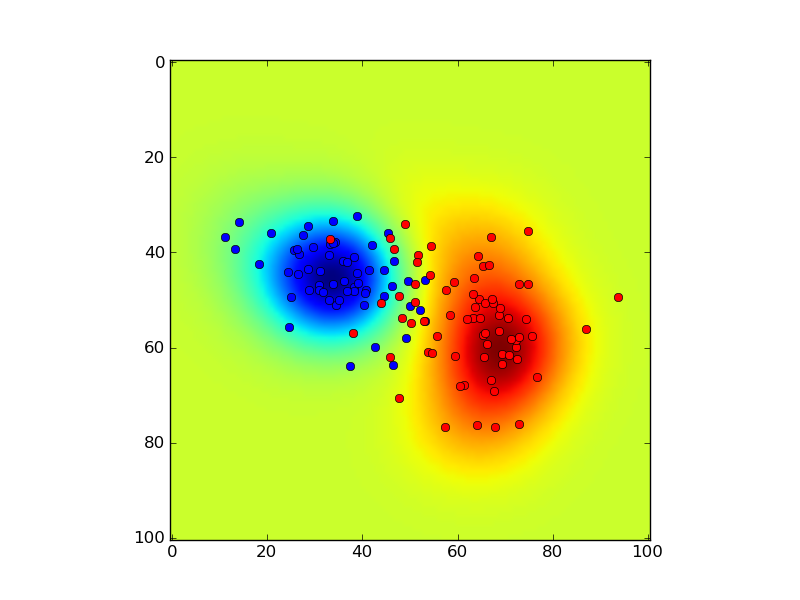

About: The UniverSVM is a SVM implementation written in C/C++. Its functionality comprises large scale transduction via CCCP optimization, sparse solutions via CCCP optimization and data-dependent [...] Changes:Minor changes: fix bug on set_alphas_b0 function (thanks to Ferdinand Kaiser - ferdinand.kaiser@tut.fi)
|
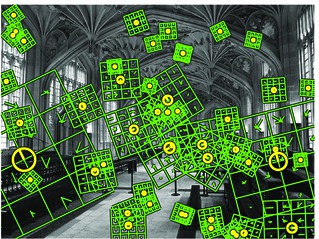
About: An implementation of MROGH descriptor. For more information, please refer to: “Bin Fan, Fuchao Wu and Zhanyi Hu, Aggregating Gradient Distributions into Intensity Orders: A Novel Local Image Descriptor, CVPR 2011, pp.2377-2384.” The most up-to-date information can be found at : http://vision.ia.ac.cn/Students/bfan/index.htm Changes:Initial Announcement on mloss.org.
|
About: The VLFeat open source library implements popular computer vision algorithms including affine covariant feature detectors, HOG, SIFT, MSER, k-means, hierarchical k-means, agglomerative information bottleneck, SLIC superpixels, and quick shift. It is written in C for efficiency and compatibility, with interfaces in MATLAB for ease of use, and detailed documentation throughout. It supports Windows, Mac OS X, and Linux. The latest version of VLFeat is 0.9.16. Changes:VLFeat 0.9.16: Added VL_COVDET() (covariant feature detectors). This function implements the following detectors: DoG, Hessian, Harris Laplace, Hessian Laplace, Multiscale Hessian, Multiscale Harris. It also implements affine adaptation, estiamtion of feature orientation, computation of descriptors on the affine patches (including raw patches), and sourcing of custom feature frame. Addet the auxiliary function VL_PLOTSS(). This is the second point update supported by the PASCAL Harvest programme. VLFeat 0.9.15: Added VL_HOG() (HOG features). Added VL_SVMPEGASOS() and a vastly improved SVM implementation. Added IHASHSUM (hashed counting). Improved INTHIST (integral histogram). Added VL_CUMMAX(). Improved the implementation of VL_ROC() and VL_PR(). Added VL_DET() (Detection Error Trade-off (DET) curves). Improved the verbosity control to AIB. Added support for Xcode 4.3, improved support for past and future Xcode versions. Completed the migration of the old test code in toolbox/test, moving the functionality to the new unit tests toolbox/xtest. Improved credits. This is the first point update supported by the PASCAL Harvest (several more to come shortly).
|
About: THIS VERSION DISCONTINUED, see "http://mloss.org/software/view/424/". This library provides ways of computing generalised 2nd-order Stirling numbers for Pitman-Yor and Dirichlet processes. Included is a tester and parameter optimiser. This accompanies Buntine and Hutter's article: http://arxiv.org/abs/1007.0296 Changes:See the alternative MLOSS entry "libstb". Updated to 1.4!
|
About: svm-struct-matlab is a MATLAB wrapper of T. Joachims' SVM^struct solver for structured output support vector machines. Changes:Adds support for Xcode 4.0 and Mac OS X 10.7 and greater.
|
About: Text-to-Speech (TTS) is a kind of speech processing technology that converts text into speech. It involves phonetics, linguistics, digital signal processing technology, computer technology, multimedia technology, and other technologies. It is a frontier technology in Chinese information processing field. With TTS technology, any text used to be read by eyes can also be listened by ears. Changes:Initial Announcement on mloss.org.
|
|
About: Link Prediction Made Easy Changes:v1.2.2
|
About: mlpy is a Python module for Machine Learning built on top of NumPy/SciPy and of GSL. Changes:New features:
Fix:
|

About: NaN-toolbox is a statistics and machine learning toolbox for handling data with and without missing values. Changes:Changes in v.2.5.2 - faster version of quantile if multiple quantiles are requested - removes the dependency on ZLIB and thus - fixes "pkg install nan" for Octave on Windows - a number of minor improvements For details see the CHANGELOG at http://pub.ist.ac.at/~schloegl/matlab/NaN/CHANGELOG
|
About: Locally Weighted Projection Regression (LWPR) is a recent algorithm that achieves nonlinear function approximation in high dimensional spaces with redundant and irrelevant input dimensions. At its [...] Changes:Version 1.2.4
|
About: Infrastructure for representing, manipulating and analyzing transaction data and frequent patterns. Changes:Initial Announcement on mloss.org.
|